
Showing That We Cared
How PRM Support Benefitted Refugee Women

Women’s history month was a good time to reflect on historic U.S. government leadership in the international community to increase its support for refugee women.
Ambassador Linda Thomas-Greenfield’s upcoming role as the keynote speaker at the April 9-10 America’s Role in the World conference, hosted by the Hamilton Lugar School of Global and International Studies at Indiana University, provides another good reason to think through the photo shown here. They are from a visit to recently repatriated Afghan refugees in 1997, when Assistant Secretary of State (AS) for the Bureau of Population, Refugees, and Migration (PRM) Julia Vadala Taft made an official visit, accompanied by Thomas-Greenfield, then Refugee Coordinator at the U.S. Embassy in Islamabad, Pakistan.
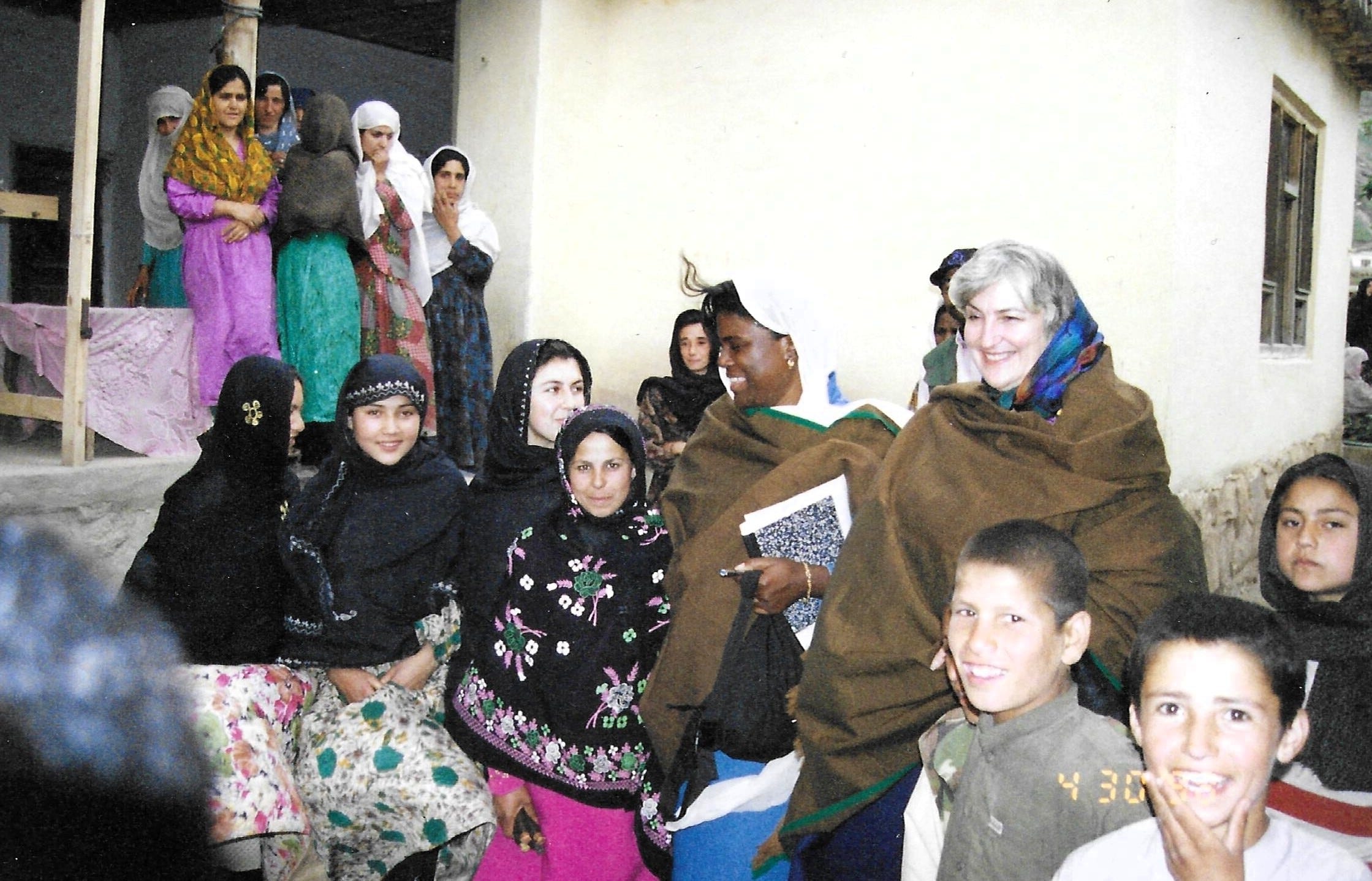
Ambassador Thomas-Greenfield recently noted that she and AS Taft received extraordinary respect from Afghans, even the Taliban, and especially Afghan women – “our trip showed that we cared.” In most situations, Afghan women were not permitted to be in public places, and male humanitarian workers could not interact with mothers, female heads of households, or other women to assess what their and their families’ needs were, or how the assistance was working to help them. PRM supported efforts to train and educate women so that they would be able to become the teachers for other women, particularly in conditions where schools were separated by gender.
Assistant Secretary Taft’s own history with refugees started as director of the 1975 President’s Interagency Task Force for Indochinese Refugees. She later served as Director of the USAID Office of Foreign Disaster Assistance (OFDA) before serving as AS for PRM from 1997 - 2001. Thomas-Greenfield was serving her third PRM tour, having worked in Washington as well as Refugee Coordinator in Nairobi, Kenya - PRM’s first “RefCoord” in Africa. She went on to be the Counselor for Refugee and Migration Affairs at the U.S. Mission to the UN in Geneva and Ambassador to Liberia before serving as the U.S. Ambassador to the United Nations in New York from 2021-2025.
PRM “showed that we cared” about refugee women many times over its half century of work. Reflecting on PRM’s leadership in support of refugee women highlights these initiatives:
Reproductive Health for Refugees (RHR)
PRM set up a UN interagency process to produce a handbook on reproductive health in crisis situations. PRM engaged substantively in the process, supporting technical expertise from the US Center for Disease Control (CDC) and funding to UNHCR. An interagency working group, including a coalition of over 50 governments, non-governmental organizations, and UN agencies, produced the “Reproductive Health in Refugee Situations: A Field Manual” in 1996, updated in 1999 and frequently thereafter. The manual was also used as the basis for evaluations of programs implementing the RHR guidelines.
Recognition of Sexual Violence in conflict as a violation of International Humanitarian Law (IHL)
After the Rwandan genocide as well as the armed conflicts among Serbia, Croatia, and Bosnia in the mid-1990’s, it became apparent that widespread sexual violence had been used as a means to try to demean or dilute ethnic groups. The international Criminal Tribunals for Rwanda (1998) and the former Yugoslavia (2001) each explicitly included rape as a crime against humanity and a violation of IHL. PRM had funding specifically to uphold IHL provisions regarding civilians in armed conflict.
PRM started providing dedicated funding to address gender-based violence (GBV) in overseas assistance programs in 2000. Critically, PRM’s GBV programming included efforts not only to respond to instances of GBV, but also to find ways to prevent GBV by addressing root causes, empowering women and girls. This included education programs for Afghan women and girls, livelihoods programs in Africa and the Middle East, and efforts to develop local capacity to provide medical and psychological support to survivors.
PRM used its targeted GBV funding and its relationship with international organizations to promote innovation and to improve global standards and policies. In June 2008, Secretary of State Condoleezza Rice, while chairing the UN Security Council (UNSC), presided over the adoption of UNSC Resolution 1820, which recognized that “rape and other forms of sexual violence can constitute a war crime, a crime against humanity, or a constitutive act with respect to genocide.”
Prevention of Sexual Exploitation and Abuse (PSEA)
In the wake of widespread exploitation and abuse of refugee women in West Africa, in 2002 PRM urged the Inter-Agency Standing Committee (IASC) – the consortia of UN, NGOs, and other international actors involved in humanitarian response – to establish six core principles for the prevention of sexual exploitation and abuse that all humanitarian organizations pledged to uphold. In 2003, PRM led negotiations of a UNHCR conclusion laying out a plan of action for UNHCR and NGOs to address and prevent abuse in the future, particularly in field operations. The UN adopted principles across the UN system that same year. PRM continued to advocate for strengthened PSEA efforts, prompting the creation of the IASC task force on PSEA in March 2002. In 2012, following a global review two years prior, it was reconstituted and developed minimum operating standards to operationalize the six core principles.
Safe from the Start
Recognizing that too often GBV response remained reactive and basic risk reduction efforts (like ensuring lighting existed near latrines) remained afterthoughts in humanitarian planning, PRM, in partnership with USAID, launched Safe from the Start in 2013 to proactively reduce GBV risk and include GBV response at the outset of emergencies. Through this flagship effort, PRM sought to ensure partners had the knowledge and capacity to plan for and provide quality services for survivors through timely and effective humanitarian action.
PRM worked with USAID counterparts to coordinate efforts across the humanitarian system, taking the lead working with its principal partners, including the International Committee of the Red Cross (ICRC), UNHCR, the UN Relief and Works Agency for Palestine Refugees in the Near East (UNRWA), the International Organization for Migration (IOM) and NGOs to build response capacity across sectors.
These are not the only PRM efforts to advance protection for women in conflict or forcibly displaced situations, but it was good to go back a few decades to see how we helped “get things started” to acknowledge that securing protection for forcibly displaced people requires knowing who the population is, what they have endured, and what pressures they face in their displacement.
Further Reading
International Violence Against Women: U.S. Response and Policy Issues, Congressional Research Service, July 26, 2021
Prevention and Criminal Repression of Rape and Other Forms of Sexual Violence during Armed Conflicts , Advisory Service on International Humanitarian Law, ICRC, March 2015
Security Council Resolution 1820 adopted June 19, 2008
 | A guest post by
|
Honor to have worked alongside you and in PRM as a Deputy Spokesperson in this bureau.